
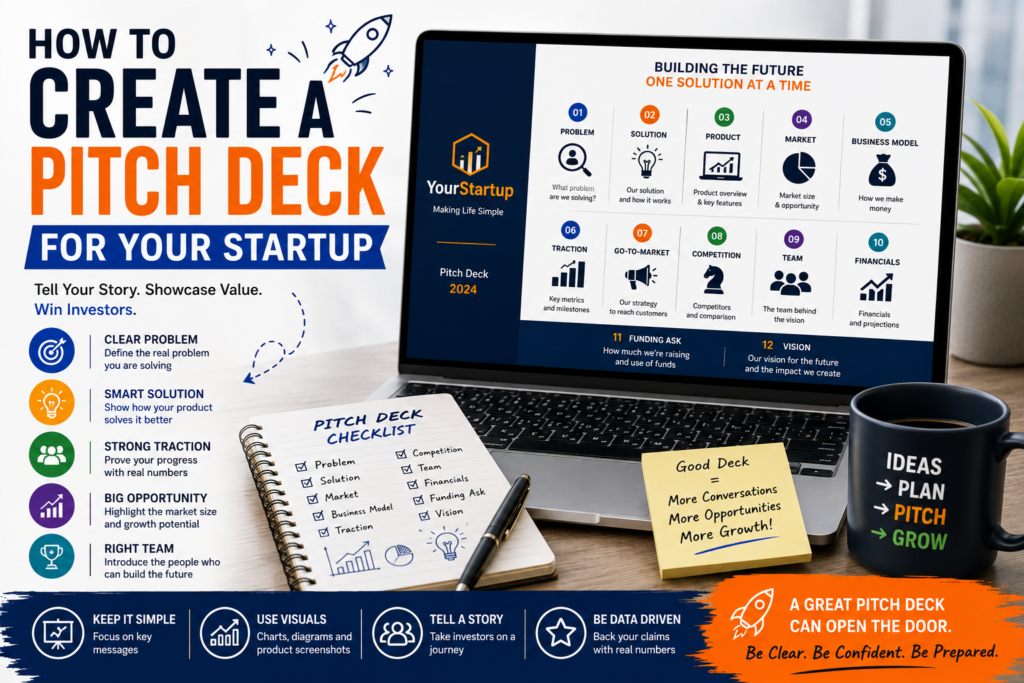
A pitch deck is a short presentation that explains your startup to investors, partners, customers or other stakeholders.
A good pitch deck should answer one simple question:
Why should someone believe in this startup and invest in its future?
You don’t need 50 slides. A focused 10–15 slide deck is usually enough to tell your story clearly.
1. Cover Slide
Start with a simple introduction.
Include:
- Startup name
- Logo
- One-line tagline
- Founder name
- Contact details
Example:
Wedsfy
Making Wedding Planning Simple
Avoid filling the first slide with too much information.
2. Problem
Explain the problem your startup is solving.
Answer:
- What is the problem?
- Who faces it?
- How frequently does it occur?
- How serious is it?
- Why are existing solutions insufficient?
Use real examples, customer feedback or data wherever possible.
Example:
Couples struggle to find reliable wedding vendors, compare prices and manage multiple bookings in one place.
Make the problem easy to understand in 10–20 seconds.
3. Solution
Now explain how your startup solves the problem.
Show:
- Your product
- How it works
- Key features
- Main benefits
Focus on the outcome, not just features.
Instead of:
“Our platform has chat, vendor profiles and payment features.”
Say:
“Our platform allows couples to discover, compare and book wedding vendors from one place.”
4. Product
Show the actual product.
Use:
- Screenshots
- Product mockups
- App screens
- Website images
- Product demo
- Workflow diagrams
If you have an MVP, show it.
Show, don’t just tell.
5. Target Market
Explain who will buy your product.
Define:
- Target customers
- Customer segments
- Geography
- Market size
You can introduce:
TAM
Total Addressable Market
The overall market opportunity.
SAM
Serviceable Available Market
The part of the market you can realistically serve.
SOM
Serviceable Obtainable Market
The portion you realistically aim to capture.
Avoid presenting huge market numbers without explaining how you calculated them.
6. Business Model
Explain:
How does your startup make money?
Possible models include:
- Subscription
- Commission
- Marketplace fee
- SaaS
- Advertising
- Freemium
- Transaction fee
- Licensing
- Direct sales
Example:
Vendor Subscription + Booking Commission + Featured Listings
Keep the model simple and easy to understand.
7. Traction
If you already have customers or users, this is one of your most important slides.
Show measurable results such as:
- Revenue
- Customers
- Users
- Growth rate
- Monthly recurring revenue
- Transactions
- Retention
- Partnerships
- Downloads
- Conversion rate
Example:
5,000+ Users
350+ Vendors
₹12 Lakh GMV
25% MoM Growth
Only use genuine and verifiable numbers.
8. Go-to-Market Strategy
Explain:
How will you acquire customers?
Possible channels:
- Social media
- SEO
- Paid advertising
- Direct sales
- Partnerships
- Influencer marketing
- Events
- Referrals
- Content marketing
- Community
Explain which channels you are testing and why they should work.
9. Competition
Investors want to know who else is solving the problem.
Create a simple comparison.
| Feature | Your Startup | Competitor A | Competitor B |
|---|---|---|---|
| Feature 1 | ✓ | ✓ | — |
| Feature 2 | ✓ | — | ✓ |
| Feature 3 | ✓ | ✓ | — |
| Pricing | ₹ | ₹₹ | ₹₹ |
Don’t say:
“We have no competition.”
If customers currently use spreadsheets, WhatsApp, offline vendors or manual processes, those are alternative solutions too.
10. Competitive Advantage
Explain:
Why will your startup win?
Your advantage could come from:
- Technology
- Brand
- Distribution
- Network effects
- Proprietary data
- Community
- Partnerships
- Cost advantage
- Better customer experience
- Unique product
- Strong execution
Your competitive advantage should be difficult for competitors to copy.
11. Marketing & Growth Strategy
Explain how you plan to grow.
For example:
Content → Organic Traffic → Leads → Conversion → Referral
Or:
Ads → Landing Page → Demo → Sales → Retention
Show your expected customer acquisition strategy.
12. Team
Introduce the people building the company.
Include:
- Founder
- Co-founders
- Key team members
- Relevant experience
- Previous achievements
- Important skills
Don’t list every employee.
Focus on:
Why is this team uniquely capable of solving this problem?
13. Financials
Show your financial outlook.
Depending on your stage, include:
- Revenue
- Expenses
- Gross margin
- Cash burn
- Customer acquisition cost
- Lifetime value
- Profit/loss
- Revenue projections
For projections, clearly state assumptions.
Avoid unrealistic numbers such as:
₹1 crore revenue this year → ₹100 crore next year
without explaining the growth drivers.
14. Funding Ask
If you’re raising investment, clearly state:
How much are you raising?
Then explain how you will use the money.
Example:
Raising: ₹2 Crore
Use of Funds
- 40% — Product & Technology
- 30% — Marketing & Sales
- 20% — Team
- 10% — Operations
Also mention the expected milestone this funding will help you achieve.
For example:
“This funding will help us reach 50,000 users and expand to 10 cities.”
15. Vision
End with the bigger picture.
Answer:
What can this company become in 5–10 years?
Your vision should be ambitious but believable.
Example:
“To become India’s largest technology platform for end-to-end wedding planning.”
Finish with:
Startup Name
Tagline
Founder Contact
Ideal Startup Pitch Deck Structure
A simple deck can follow this sequence:
1. Cover
↓
2. Problem
↓
3. Solution
↓
4. Product
↓
5. Market
↓
6. Business Model
↓
7. Traction
↓
8. Go-to-Market
↓
9. Competition
↓
10. Competitive Advantage
↓
11. Team
↓
12. Financials
↓
13. Funding Ask
↓
14. Vision
How to Make Your Pitch Deck Better
Keep It Simple
One slide should communicate one main idea.
Use Visuals
Use:
- Charts
- Product screenshots
- Diagrams
- Customer numbers
- Simple graphics
Instead of putting a full paragraph on every slide.
Use Data
Whenever possible, support claims with:
- Customer data
- Market research
- Revenue
- Growth
- User behavior
- Industry statistics
Tell a Story
Your deck should feel like a journey:
Problem → Solution → Market → Proof → Growth → Team → Opportunity → Ask
Common Pitch Deck Mistakes
❌ Too much text
❌ Too many slides
❌ Complicated business model
❌ Unrealistic projections
❌ No clear customer
❌ No traction or validation
❌ Saying “we have no competitors”
❌ Focusing only on features
❌ Weak financial assumptions
❌ No clear funding requirement
❌ Poor design
❌ No clear reason why your team can win
Pitch Deck Checklist
☐ Startup name & tagline
☐ Problem clearly explained
☐ Solution clearly explained
☐ Product demonstrated
☐ Target market identified
☐ Business model explained
☐ Traction included
☐ Go-to-market strategy
☐ Competition analysed
☐ Competitive advantage
☐ Team introduced
☐ Financial projections
☐ Funding requirement
☐ Use of funds
☐ Vision
☐ Founder contact details
Final Thought
A pitch deck isn’t supposed to tell investors everything about your startup.
Its job is to make them understand:
What is the problem?
Why does it matter?
What are you building?
Who wants it?
How big can it become?
Why will your team win?
What have you achieved?
What do you need to reach the next stage?
A strong pitch deck doesn’t guarantee funding.
But a clear, credible and well-structured story can earn you the next conversation.
Keep it simple. Show the evidence. Tell the story. Make the opportunity clear.