
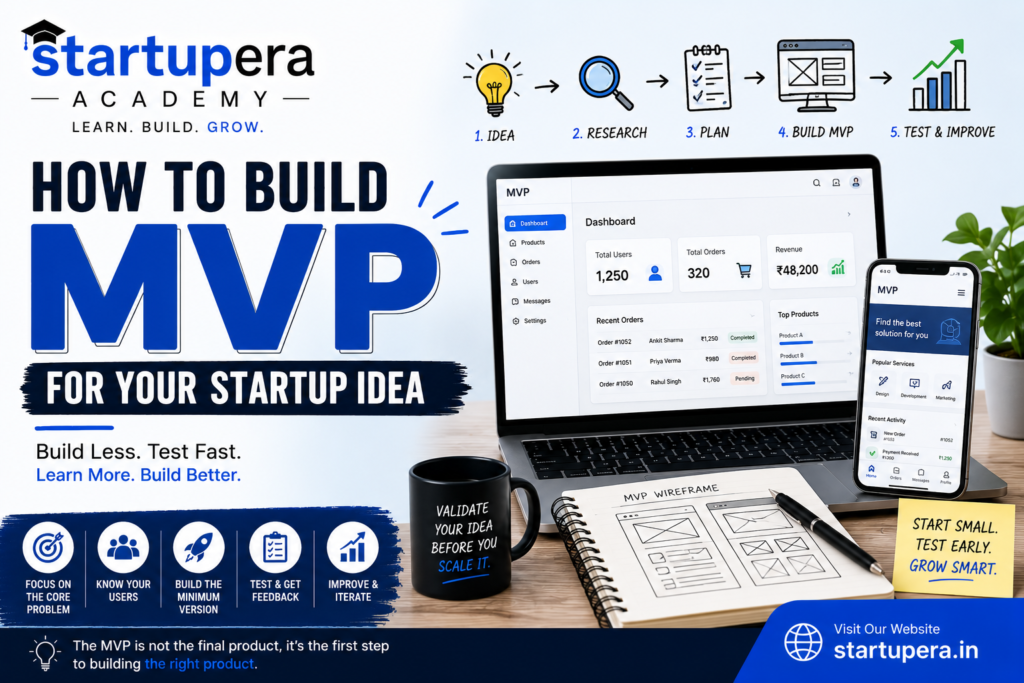
You have a startup idea. You have identified a problem. You have researched the market.
Now comes the next important question:
How do you turn your idea into something people can actually use?
This is where an MVP — Minimum Viable Product — comes in.
An MVP is the simplest version of your product that allows you to test your idea with real users, collect feedback and understand whether people actually want your solution.
1. Clearly Define the Problem
Before building anything, go back to the problem.
Ask:
- What exact problem are we solving?
- Who experiences this problem?
- How frequently does it happen?
- How are people solving it today?
- Why are existing solutions not enough?
Your MVP should solve one important problem, not ten different problems.
Example
Instead of:
“We are building an all-in-one platform for businesses.”
Start with:
“We help small businesses create and manage their social media content.”
Keep the first problem specific.
2. Define Your Target User
Know exactly who will use your MVP.
Create a simple customer profile:
Target: Small business owners
Problem: Lack of time for social media
Current solution: Hiring freelancers or doing it themselves
Need: Simple and affordable content management
A focused target audience makes MVP testing much easier.
3. Define Your Core Value Proposition
Explain your product in one sentence.
Use this format:
We help [customer] solve [problem] by [solution].
For example:
We help small businesses manage their social media by providing ready-to-publish content and simple scheduling tools.
If you cannot explain your product simply, you may need to simplify the idea.
4. Identify the One Core Feature
This is where many startups make mistakes.
They try to build everything at once.
Instead, ask:
What is the ONE feature that solves the main problem?
For example, if you’re building a food delivery startup, your MVP might focus on:
Browse restaurants → Order food → Receive delivery
You may not need:
- Loyalty points
- AI recommendations
- Multiple payment options
- Advanced analytics
- Complex memberships
Those can come later.
5. Separate Must-Have and Nice-to-Have Features
Create two lists.
Must Have
Features necessary for the product to work.
Nice to Have
Features that can be added later.
For example:
| Must Have | Later |
|---|---|
| User registration | Social login |
| Product listing | AI recommendations |
| Search | Personalised suggestions |
| Payment | Loyalty program |
| Order tracking | Advanced analytics |
Build the Must Have list first.
6. Choose the Right MVP Type
You don’t always need to build a complete app.
Your MVP could be:
Landing Page MVP
Explain the product and collect leads.
Prototype MVP
Create clickable screens to test the user experience.
No-Code MVP
Use no-code tools to launch quickly.
Manual MVP
Deliver the service manually behind the scenes.
WhatsApp MVP
Use WhatsApp to test the business before building technology.
Basic Website
Useful for testing marketplaces, services and SaaS ideas.
Functional App
Build a simple working version when technology is essential to the product.
The best MVP is not necessarily the most technically advanced one.
It’s the fastest way to test your biggest assumption.
7. Create a Simple User Flow
Map the customer’s journey.
For example:
Open Website
↓
Create Account
↓
Choose Service
↓
Make Payment
↓
Receive Service
Keep the journey as simple as possible.
Every unnecessary step can create friction.
8. Create a Prototype
Before spending significant money on development, create a basic prototype.
You can design:
- Home screen
- Login
- Dashboard
- Main feature
- Checkout/payment
- Confirmation page
A prototype helps you identify problems before development begins.
You can show it to potential customers and ask:
“What would you expect to happen next?”
Watch how they interact with it.
9. Build the MVP
Now build only what is necessary.
Your development approach could involve:
- A developer
- Internal technical team
- No-code tools
- Low-code platforms
- Freelancers
- Development agency
Focus on:
Functionality → Usability → Reliability
Not perfection.
10. Launch to a Small Group
Don’t immediately launch to 100,000 people.
Start with a small group.
For example:
10 → 25 → 50 → 100 users
This makes it easier to:
- Find bugs
- Understand behavior
- Collect feedback
- Improve onboarding
- Test pricing
- Improve the product
Your first users are your learning partners.
11. Collect Real Feedback
Ask users:
- What did you like?
- What was confusing?
- What was missing?
- What would you change?
- Would you use it again?
- Would you pay for it?
- Would you recommend it?
Don’t just collect compliments.
Look for specific problems and behaviors.
12. Measure User Behavior
Feedback is useful, but behavior is even more valuable.
Track metrics such as:
Activation
How many users actually reach the main value of the product?
Retention
How many users come back?
Conversion
How many users become customers?
Engagement
How frequently do they use the product?
Revenue
Are people willing to pay?
For example:
1,000 visitors
↓
300 signups
↓
150 active users
↓
40 paying customers
These numbers tell you much more about your MVP than downloads alone.
13. Test Willingness to Pay
An MVP isn’t fully validated just because people like it.
The stronger question is:
Will someone pay for it?
Test:
- Paid trials
- Pre-orders
- Subscriptions
- Paid pilots
- Deposits
- Service fees
Even a small number of paying customers can provide valuable evidence.
14. Improve the MVP
Use the feedback to decide what happens next.
If users love it:
Improve and expand.
If users like it but don’t pay:
Reconsider pricing, positioning or value.
If users don’t understand it:
Improve the product and communication.
If users don’t need it:
Change the idea or target customer.
This creates a continuous cycle:
Build → Launch → Measure → Learn → Improve
15. Don’t Add Features Too Quickly
One of the biggest startup problems is feature overload.
Users request many features.
You don’t have to build all of them.
Ask:
Does this feature solve an important customer problem?
Will it improve retention or revenue?
Is it necessary right now?
If not, keep it for later.
Example: Building an MVP
Imagine you want to create a wedding vendor marketplace.
Full Product
You might eventually want:
- Vendor profiles
- Search
- Filters
- Booking
- Payments
- Chat
- Reviews
- Wedding planning
- Budget management
- Guest management
- Recommendations
That’s a large product.
MVP
Start with:
Couple → Search Vendors → View Profile → Contact/Book Vendor
Then test whether couples actually use it and whether vendors are willing to participate.
Once validated, add more features.
MVP Development Roadmap
Week 1
Problem + Customer
Identify the problem and target user.
Week 2
Research + User Interviews
Talk to potential customers.
Week 3
Feature Selection
Identify the core feature.
Week 4
Prototype
Create the basic user experience.
Weeks 5–8
Build MVP
Develop the simplest functional version.
Week 9
Launch
Give it to your first users.
Weeks 10–12
Measure + Improve
Collect feedback, analyse behavior and make improvements.
The exact timeline depends heavily on the product, team and technology.
Common MVP Mistakes
❌ Building too many features
❌ Spending too much money
❌ Taking too long to launch
❌ Building without customer research
❌ Ignoring user feedback
❌ Focusing on design instead of value
❌ Launching without measuring results
❌ Assuming downloads equal success
❌ Waiting for the product to be perfect
MVP Formula
Problem
↓
Target Customer
↓
Core Value
↓
One Key Feature
↓
Prototype
↓
MVP
↓
Real Users
↓
Feedback & Data
↓
Improve
↓
Product-Market Fit
Final Thought
Your first product doesn’t need to be perfect.
It needs to answer one important question:
Do people actually want what we’re building?
Build the smallest useful version, launch it quickly, listen to your customers and improve based on evidence.
Don’t build everything first. Build enough to learn.