
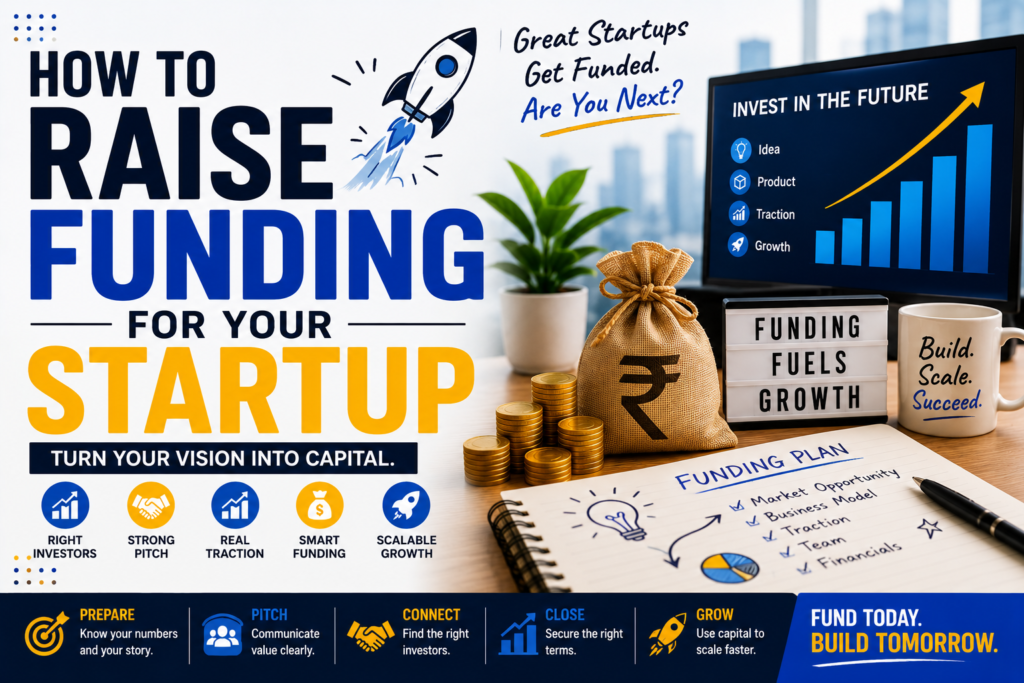
Raising funding can help a startup build its product, hire talent, acquire customers and expand into new markets.
But funding should not be the first goal of every startup.
First build something valuable. Then prove that people want it. Then raise money to accelerate growth.
Here is a practical roadmap for raising startup funding.
1. Understand Why You Need Funding
Before approaching investors, answer:
Why does your startup need money?
Common reasons include:
- Product development
- Technology
- Hiring
- Marketing
- Sales
- Manufacturing
- Working capital
- Geographic expansion
- Customer acquisition
Don’t raise money simply because:
“Every startup needs funding.”
Raise when capital can help you reach a meaningful business milestone.
2. Know How Much You Need
Calculate your funding requirement carefully.
For example:
Product Development: ₹30 lakh
Team: ₹25 lakh
Marketing: ₹20 lakh
Operations: ₹10 lakh
Working Capital: ₹15 lakh
Total: ₹1 crore
Your funding requirement should be based on actual business assumptions rather than an arbitrary number.
3. Understand Startup Funding Stages
Different funding stages usually correspond to different levels of business development.
Bootstrapping
Founder uses personal savings or business revenue.
Pre-Seed
Usually focused on:
- Idea
- Prototype
- MVP
- Early validation
Seed
Usually focused on:
- Product-market fit
- Early customers
- Revenue
- Initial growth
Series A
Typically for startups with stronger traction looking to scale.
Series B & Beyond
Usually focused on:
- Rapid expansion
- Larger teams
- New markets
- Scaling operations
Not every startup needs to go through every funding stage.
4. Start With Bootstrapping
Before approaching external investors, consider whether you can build the first version using your own resources.
You can use:
- Personal savings
- Founder income
- Early customer revenue
- Pre-orders
- Consulting/service revenue
- Friends and family, where appropriate
Bootstrapping can help you validate your idea while retaining more ownership.
5. Validate Your Startup
Investors don’t only invest in ideas.
They look for evidence that the problem exists and customers want your solution.
Try to demonstrate:
- Customer interviews
- MVP
- Early users
- Paying customers
- Revenue
- Repeat usage
- Partnerships
- Customer retention
- Growth
The stronger your validation, the stronger your funding story can become.
6. Build Your MVP
You don’t necessarily need a complete product before raising early-stage funding.
Build an MVP — Minimum Viable Product that allows you to test your core assumption.
For example:
Instead of building a complete marketplace with 50 features, start with:
Customer → Vendor Discovery → Booking → Payment
Then learn from actual users.
7. Create a Strong Business Model
Investors need to understand:
How will this startup make money?
Explain:
- Customer
- Product
- Pricing
- Revenue model
- Costs
- Distribution
- Gross margins
- Growth potential
Possible models include:
- Subscription
- Marketplace commission
- SaaS
- Transaction fees
- Advertising
- Licensing
- Direct sales
- Freemium
8. Know Your Market Size
Investors want to understand how large the opportunity can become.
Use:
TAM
Total Addressable Market
The overall potential market.
SAM
Serviceable Available Market
The part of the market your business can serve.
SOM
Serviceable Obtainable Market
The realistic portion you can capture.
Don’t simply say:
“The Indian market is worth ₹1 lakh crore.”
Explain where the number comes from and what portion is actually relevant to your business.
9. Create Your Pitch Deck
Your pitch deck is one of the most important fundraising documents.
A typical deck can include:
- Cover
- Problem
- Solution
- Product
- Market
- Business model
- Traction
- Go-to-market strategy
- Competition
- Competitive advantage
- Team
- Financials
- Funding ask
- Vision
Your pitch deck should tell a clear story.
Problem → Solution → Market → Proof → Growth → Team → Funding
10. Show Traction
Traction is evidence that your startup is moving forward.
Depending on your business, show:
- Revenue
- Number of customers
- Active users
- Growth rate
- Monthly recurring revenue
- Transactions
- Retention
- Partnerships
- Downloads
- Conversion rate
For example:
10,000 users
500 paying customers
₹25 lakh annual revenue
20% monthly growth
Only present genuine numbers and clearly define what each metric means.
11. Prepare Your Financial Model
Investors will want to understand your financial assumptions.
Prepare projections covering:
- Revenue
- Expenses
- Gross margin
- Operating costs
- Cash burn
- Customer acquisition cost
- Lifetime value
- Break-even
- Cash runway
Create realistic scenarios:
Base Case
Optimistic Case
Conservative Case
Your financial model should explain how the business grows, not just show impressive numbers.
12. Decide What Type of Investor You Need
Different investors can be appropriate at different stages.
Angel Investors
Individual investors who may invest their own money.
Angel Networks
Groups of angel investors who evaluate startup opportunities.
Venture Capital Funds
Professional investment firms generally looking for startups with significant growth potential.
Corporate/Strategic Investors
Companies that invest because the startup has strategic relevance.
Accelerators
Programs that may provide funding, mentorship, resources and networks.
Choose investors based on:
- Stage
- Sector
- Geography
- Investment size
- Expertise
- Network
- Portfolio
- Follow-on capacity
13. Research Investors Before Contacting Them
Don’t send the same pitch to every investor.
Research:
- What stage do they invest in?
- What sectors do they focus on?
- Typical cheque size
- Geography
- Existing portfolio
- Previous investments
- Founder references
If an investor only invests in deep-tech companies and your startup is a consumer marketplace, they may not be the right target.
14. Build Investor Relationships
Fundraising isn’t only about sending emails.
Start building relationships before you need money.
You can meet investors through:
- Startup events
- Founder communities
- Accelerators
- Industry conferences
- Warm introductions
- Startup competitions
- Angel networks
A warm introduction can often be more effective than a completely cold approach.
15. Create a Strong Founder Story
Investors invest in businesses, but they also evaluate founders.
Be prepared to explain:
- Why did you start?
- Why this problem?
- Why now?
- Why are you the right person?
- What have you learned?
- What have you achieved?
- What is your long-term vision?
Your story should be authentic.
Don’t create a dramatic story simply to impress investors.
16. Prepare Your Investor Outreach
Keep your first message short.
Example
Subject: [Startup Name] — [One-line description]
Hi [Investor Name],
I’m building [Startup], a platform helping [target customer] solve [specific problem].
We currently have [traction/validation]. We’re raising ₹X to achieve [specific milestones].
I’d love to share our pitch deck and explore whether this fits your investment focus.
The objective of the first message is usually to start a conversation—not explain your entire company.
17. Use Warm Introductions
Ask people in your network:
- Founders
- Mentors
- Advisors
- Industry professionals
- Existing investors
- Accelerator contacts
if they can introduce you to relevant investors.
A simple introduction can look like:
“I’d like to introduce [Founder], who is building [Startup] for [market]. They currently have [traction] and are raising [amount].”
18. Be Ready for Investor Questions
Investors may ask:
Market
- How big is the opportunity?
- Why now?
Product
- How does it work?
- What makes it different?
Customers
- Who is paying?
- How do you acquire them?
Competition
- Who else is doing this?
- Why will you win?
Financials
- What is your revenue?
- What are your margins?
- How much are you burning?
Team
- Why are you the right team?
Funding
- How much are you raising?
- How will you use it?
- How long will it last?
Prepare concise, data-backed answers.
19. Understand Valuation
When raising equity funding, investors typically receive ownership in exchange for capital.
For example:
Company valuation before investment: ₹9 crore
Investment: ₹1 crore
Post-money valuation: ₹10 crore
The investor would own approximately:
₹1 crore ÷ ₹10 crore = 10%
This is a simplified example.
Actual startup valuation and deal structures can involve many additional factors.
20. Understand Dilution
When you issue new shares to investors, existing shareholders can be diluted.
For example:
Before investment:
Founder — 100%
After raising investment:
Founder — 80%
Investor — 20%
Dilution isn’t necessarily bad.
If the investment helps the company become significantly more valuable, owning a smaller percentage of a much larger company can still be beneficial.
21. Create a Cap Table
A capitalisation table (cap table) shows ownership of the company.
It can include:
- Founders
- Co-founders
- Investors
- ESOP pool
- Shareholding
- Securities issued
Maintain an accurate cap table from the beginning.
It becomes increasingly important as you raise multiple rounds.
22. Prepare Your Legal Documents
Investors will typically conduct due diligence before completing an investment.
Keep your records organised.
Depending on your startup, this can include:
- Incorporation documents
- Shareholding records
- Financial statements
- Tax records
- Material contracts
- Employment agreements
- IP ownership documents
- Customer/supplier contracts
- Regulatory registrations
- Previous investment documents
- Cap table
Clean documentation can make the fundraising process much smoother.
23. Protect Your Intellectual Property
Make sure the startup has proper ownership or rights over:
- Software
- Brand
- Logo
- Designs
- Patents
- Content
- Databases
- Technology
If your developers, freelancers or agencies created important IP, make sure appropriate agreements address ownership.
Investors may examine IP ownership during due diligence.
24. Understand the Term Sheet
If an investor wants to invest, they may provide a term sheet outlining key commercial terms.
It can cover areas such as:
- Investment amount
- Valuation
- Ownership
- Liquidation preference
- Board rights
- Voting rights
- Founder matters
- Anti-dilution provisions
- ESOP pool
- Exit provisions
Don’t sign a term sheet without understanding its implications.
Get qualified legal and financial advice for your specific transaction.
25. Complete Due Diligence
Before investment closes, the investor may examine your business.
They may review:
Legal → Financial → Tax → IP → Customers → Team → Technology → Compliance
Keep your documents organised in a secure data room.
26. Close the Investment Properly
Once commercial and legal terms are finalised, complete the necessary documentation and corporate/regulatory processes.
Depending on the transaction, this may involve:
- Definitive agreements
- Share issuance
- Board/shareholder approvals
- Regulatory filings
- Banking documentation
- Updating the cap table
The exact process depends on the structure of the investment and the company.
27. Use Funding for Milestones
After raising money, don’t treat it as unlimited cash.
Convert funding into measurable goals.
For example:
₹1 Crore Funding
→ Build MVP
→ Hire 4 key employees
→ Acquire 5,000 customers
→ Reach ₹50 lakh ARR
→ Expand to 3 cities
Your investors will want to see progress against the milestones you committed to.
28. Maintain Investor Communication
Once you raise funding, maintain professional communication.
Consider sending regular updates covering:
- Revenue
- Growth
- Customers
- Product
- Hiring
- Challenges
- Cash position
- Major achievements
- Next priorities
Investors can become valuable partners when communication is transparent.
Startup Funding Roadmap
Validate Idea
↓
Build MVP
↓
Get Early Customers
↓
Generate Traction
↓
Define Funding Requirement
↓
Prepare Pitch Deck
↓
Build Financial Model
↓
Research Investors
↓
Start Investor Outreach
↓
Investor Meetings
↓
Due Diligence
↓
Term Sheet
↓
Legal Documentation
↓
Investment Closing
↓
Deploy Capital
↓
Achieve Milestones
Common Fundraising Mistakes
❌ Raising money before validating the problem
❌ Asking for an arbitrary amount
❌ Sending the same pitch to every investor
❌ Having unrealistic projections
❌ Ignoring competition
❌ Not knowing your numbers
❌ Giving away too much equity too early
❌ Ignoring legal documentation
❌ Poor cap-table management
❌ Using investment without clear milestones
❌ Treating investors only as sources of money
❌ Taking a deal without understanding its terms
Startup Funding Checklist
☐ Problem validated
☐ MVP/product developed
☐ Early customers/users
☐ Business model defined
☐ Market size researched
☐ Traction metrics prepared
☐ Pitch deck completed
☐ Financial model prepared
☐ Funding requirement calculated
☐ Investor list created
☐ Investor outreach started
☐ Legal documents organised
☐ IP ownership checked
☐ Cap table prepared
☐ Due diligence documents ready
☐ Professional legal/financial advice obtained
Final Thought
Funding is fuel, not the destination.
The goal isn’t simply to raise ₹50 lakh, ₹1 crore or ₹10 crore.
The goal is to use capital to build a stronger company.
A good fundraising story is:
Problem → Solution → Market → Traction → Business Model → Team → Growth → Funding → Milestones
Build something people want.
Prove that they want it.
Then raise capital to grow faster and create more value.