
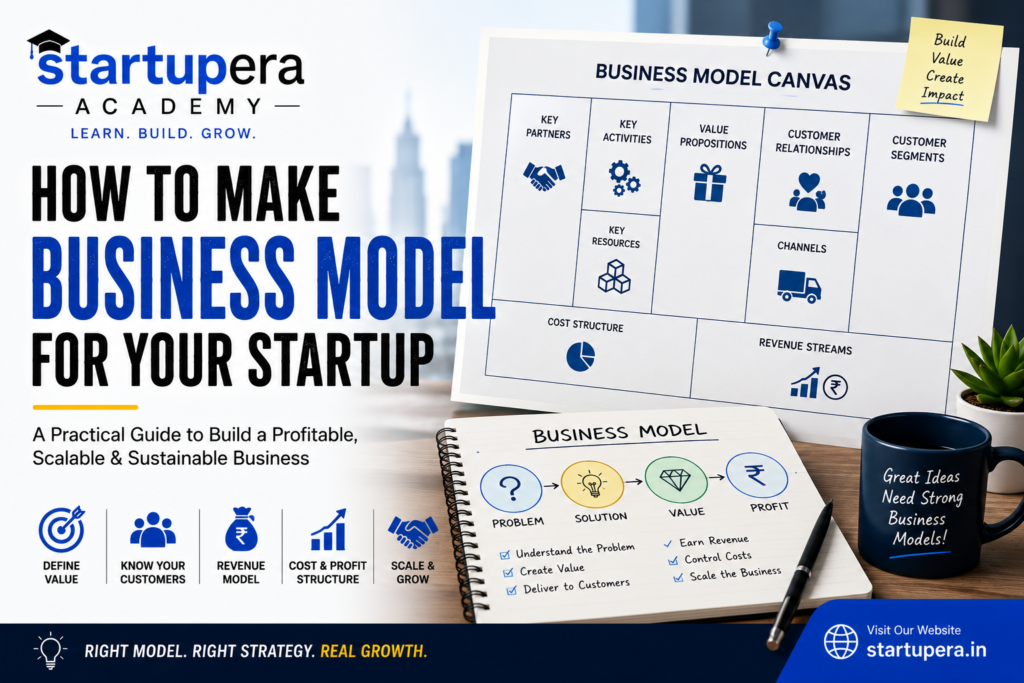
A great startup idea is not enough to build a successful business. You also need a business model that explains how your startup will create value, deliver it to customers, and make money.
A business model answers one simple question:
How will this startup become a sustainable business?
Here is a simple step-by-step approach.
1. Define the Problem
Start with the problem your startup is solving.
Ask:
- What problem are you solving?
- Why is it important?
- Who experiences it?
- How are people solving it today?
- Why are existing solutions not enough?
Example:
Small businesses struggle to manage their social media consistently.
2. Define Your Target Customer
Clearly identify who will pay for your product or service.
Consider:
- Individuals or businesses?
- Age group
- Location
- Profession
- Income
- Business size
- Needs and buying behavior
Instead of saying “Everyone is our customer,” define a specific segment.
Example:
Local restaurants with 5–50 employees.
3. Define Your Value Proposition
Your value proposition explains why customers should choose you.
A simple formula:
We help [customer] solve [problem] through [solution].
Example:
We help local restaurants increase online visibility through affordable, managed social media marketing.
Your value proposition should be:
- Clear
- Specific
- Useful
- Easy to understand
- Customer-focused
4. Decide What You Will Sell
Define your actual product or service.
It could be:
- Software
- Mobile app
- Physical product
- Consulting
- Subscription
- Marketplace
- Online course
- Managed service
- Platform
Clearly define what the customer receives after paying you.
5. Choose Your Revenue Model
This is one of the most important parts of your business model.
Common revenue models include:
Subscription
Customers pay monthly or annually.
Example: ₹999/month.
Commission
You take a percentage from every transaction.
Example: 10% commission on bookings.
One-Time Purchase
Customer pays once for the product.
Freemium
Basic features are free; advanced features are paid.
Advertising
Businesses pay you to reach your audience.
Service Model
Customers pay for professional services.
Marketplace
You connect buyers and sellers and earn through commissions or fees.
Choose the model that matches how your customers prefer to buy.
6. Set Your Pricing
Don’t randomly choose a price.
Consider:
Customer value + Competitor pricing + Your costs + Customer willingness to pay
You can test different pricing options.
For example:
Basic: ₹499/month
Professional: ₹999/month
Business: ₹2,499/month
Your pricing should support both customer value and business profitability.
7. Identify Your Customer Acquisition Channels
How will customers discover your startup?
Possible channels:
- Google Search
- SEO
- YouTube
- Google Ads
- Meta Ads
- Partnerships
- Events
- Referrals
- Direct sales
- Influencer marketing
Don’t try every channel at once.
Start with the channels where your target customers already spend time.
8. Define Your Customer Relationship
Think about how you will interact with customers.
Will you provide:
- Self-service?
- Personal support?
- Account managers?
- Chat support?
- Community?
- Automated onboarding?
- Training?
Good customer experience can become a competitive advantage.
9. Identify Key Activities
What must your startup do every day to deliver its value?
Examples:
- Product development
- Marketing
- Sales
- Customer support
- Delivery
- Research
- Content creation
- Operations
- Technology management
Focus on activities that directly contribute to customer value.
10. Identify Key Resources
What do you need to operate?
Resources can include:
- Team
- Technology
- Website
- Mobile application
- Equipment
- Intellectual property
- Data
- Capital
- Brand
- Partnerships
Separate must-have resources from things you can add later.
11. Build Strategic Partnerships
You don’t have to do everything yourself.
Potential partners could include:
- Technology providers
- Distributors
- Suppliers
- Marketing partners
- Payment providers
- Universities
- Corporates
- Industry associations
- Freelancers
- Other startups
The right partnership can reduce costs and help you reach customers faster.
12. Calculate Your Costs
List your major expenses.
Fixed Costs
Costs that don’t change much with sales:
- Salaries
- Office rent
- Software subscriptions
- Hosting
- Professional fees
Variable Costs
Costs that increase with business activity:
- Advertising
- Delivery
- Payment processing
- Packaging
- Sales commissions
- Customer acquisition
Then calculate:
Revenue – Costs = Profit
13. Understand Unit Economics
Unit economics tells you whether acquiring and serving one customer makes financial sense.
Important metrics include:
CAC — Customer Acquisition Cost
How much does it cost to acquire one customer?
CAC = Total Sales & Marketing Cost ÷ New Customers
LTV — Customer Lifetime Value
How much revenue or contribution does a customer generate during their relationship with your business?
A startup generally wants the value generated by a customer to comfortably exceed the cost of acquiring and serving that customer.
14. Identify Your Competitive Advantage
Ask:
Why can’t competitors easily copy us?
Your advantage could come from:
- Technology
- Brand
- Data
- Network effects
- Distribution
- Community
- Expertise
- Better customer experience
- Lower cost
- Proprietary technology
- Strong partnerships
A feature is not always a competitive advantage.
15. Use the Business Model Canvas
A simple way to organize your startup business model is the Business Model Canvas.
It has 9 key blocks:
| Block | Question |
|---|---|
| Customer Segments | Who are your customers? |
| Value Proposition | What value do you provide? |
| Channels | How will you reach customers? |
| Customer Relationships | How will you serve them? |
| Revenue Streams | How will you make money? |
| Key Resources | What do you need? |
| Key Activities | What must you do? |
| Key Partners | Who can help you? |
| Cost Structure | What will it cost? |
Put these nine blocks on one page.
Now you have a basic picture of how your startup works.
Example: Startup Business Model
Imagine you’re creating a wedding vendor marketplace.
Customer Segments
- Couples
- Wedding vendors
Value Proposition
- Couples can discover and book vendors.
- Vendors can find potential customers.
Channels
- Website
- Mobile app
- SEO
- Paid advertising
Revenue
- Vendor subscription
- Booking commission
- Featured listings
- Advertising
Key Activities
- Platform development
- Vendor onboarding
- Marketing
- Customer support
Key Resources
- Technology
- Team
- Vendor network
- Customer data
Key Partners
- Wedding vendors
- Venues
- Photographers
- Wedding planners
Costs
- Technology
- Marketing
- Salaries
- Operations
- Customer support
This creates a basic business model that can then be tested with real customers.
Test Your Business Model
Don’t assume your business model will work.
Test each major assumption.
Customer → Do they need it?
↓
Product → Will they use it?
↓
Price → Will they pay?
↓
Revenue → Can you make enough money?
↓
Costs → Can you operate profitably?
↓
Scale → Can the model grow?
Common Mistakes
❌ Trying to serve everyone
❌ Choosing pricing without research
❌ Focusing only on revenue and ignoring costs
❌ Building expensive technology too early
❌ Ignoring customer acquisition costs
❌ Copying a competitor’s business model blindly
❌ Assuming more customers automatically means more profit
❌ Scaling before proving the model
Startup Business Model Formula
Problem → Customer → Value → Product → Pricing → Revenue → Distribution → Costs → Profit → Scale
The goal isn’t to create a complicated business model.
The goal is to create a model that customers want, can afford, and that your startup can deliver profitably.
Start simple, test your assumptions, learn from customers, and improve the model as your startup grows.