
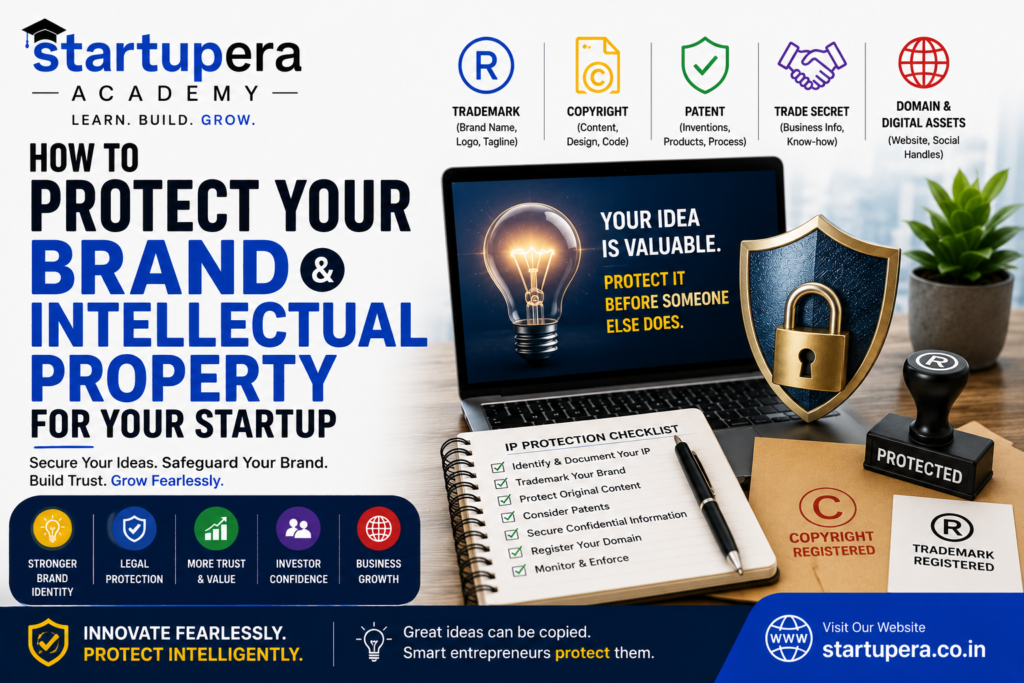
Your startup’s name, logo, software, product design, content, technology and inventions can become some of its most valuable assets.
But simply creating them doesn’t always give you the strongest protection. A smart startup should identify its intellectual property (IP) early and take appropriate steps to protect it.
Here is a simple roadmap.
1. Understand What Intellectual Property Means
Intellectual Property refers to creations of the mind that can have commercial value.
For startups, the most relevant categories are:
- Trademark — Brand name, logo, slogan, etc.
- Copyright — Software, website content, graphics, videos, written content, etc.
- Patent — Eligible new inventions and technical solutions
- Design Registration — Protects eligible visual/design aspects of products
- Trade Secrets — Confidential business information, processes, strategies and data
Each type protects something different.
2. Protect Your Brand Name With a Trademark
Your startup name is one of your most important assets.
A trademark can protect elements such as:
- Brand name
- Logo
- Slogan
- Certain distinctive signs
- Other eligible brand identifiers
IP India’s official guidance explains that trademark registration provides statutory protection and helps the owner distinguish its goods or services from those of others. (IP India)
Example
Suppose your startup is called:
StartupX
You may consider protecting:
StartupX → Word mark
StartupX Logo → Device/logo mark
3. Search Before Choosing Your Brand
Before investing heavily in a name, check whether similar trademarks already exist.
Search for:
- Similar names
- Similar spellings
- Similar-sounding names
- Similar logos
- Similar goods/services
Also check:
- Domain availability
- Social media handles
- Existing companies
- App stores
A name being available as a domain does not necessarily mean it is safe from trademark conflicts.
IP India’s trademark guidance notes that marks that are identical or deceptively similar to existing marks may be refused. (IP India)
4. Choose the Correct Trademark Class
Trademarks are registered for particular goods or services under the Nice Classification system.
Broadly:
- Classes 1–34: Goods
- Classes 35–45: Services
Choosing the correct class and accurately describing your goods/services is important for effective protection. (IP India)
For example, a software company, clothing brand and restaurant may require different classes depending on their activities.
5. File Your Trademark Application
Once you’ve selected your brand and relevant class, you can apply for trademark registration through India’s Trade Marks Registry.
You can apply:
- Directly
- Through a registered trademark agent/attorney
IP India confirms that startups and companies can apply for trademarks. (IP India)
The application can be filed on a “proposed to be used” basis or based on prior use, subject to the applicable requirements. (IP India)
6. Understand Trademark Validity
A registered trademark is valid for 10 years from the date of application and can be renewed for further 10-year periods. (IP India)
So trademark protection should be treated as an ongoing business asset.
Maintain records of:
- Registration
- Renewal dates
- Brand usage
- Licences
- Assignments
- Enforcement actions
7. Protect Your Logo and Creative Assets
Your startup may create:
- Logo
- Website graphics
- Advertisements
- Videos
- Photography
- Blog articles
- Presentations
- Illustrations
- Software
- Training material
These may involve copyright protection.
In India, copyright generally arises automatically when an original work is created; registration is not mandatory. However, registration can serve as prima facie evidence in disputes concerning ownership. (IP India)
8. Understand What Copyright Protects
Copyright protects the expression of an idea, not the idea itself. (IP India)
For example:
Idea
“An app that connects wedding vendors with couples.”
The general idea itself isn’t protected by copyright.
Expression
Your:
- Source code
- Website copy
- Graphics
- Videos
- Original photographs
- Written content
may receive copyright protection if the legal requirements are satisfied.
9. Consider Copyright Registration
Although copyright generally exists automatically for eligible original works, registration can provide useful evidence of the claimed ownership.
This may be particularly useful for important startup assets such as:
- Software
- Original artwork
- Training content
- Major website content
- Creative campaigns
- Books/e-books
- Videos
The Copyright Office provides an online registration process. (IP India)
10. Protect Your Inventions With a Patent
If your startup has developed a genuinely new technical invention, explore patent protection before publicly disclosing it.
According to IP India’s current guidance, a patentable invention generally needs to satisfy requirements including:
- Novelty
- Inventive step
- Industrial applicability
- Not falling within statutory exclusions under the Patents Act (IP India)
Startups are among the categories of applicants that can file patent applications in India. (IP India)
11. Don’t Publicly Reveal an Invention Too Early
This is especially important for technology startups.
Before publicly sharing a potentially patentable invention, consider discussing the disclosure strategy with a patent professional.
Avoid casually publishing:
- Technical specifications
- Detailed invention documents
- Source code
- Engineering drawings
- Manufacturing processes
on websites or social media before assessing patentability.
Early disclosure can create serious IP issues depending on the circumstances.
12. Protect Product Designs
If your startup creates a unique visual design for a product, design registration may be relevant.
For example:
- Product shape
- Configuration
- Pattern
- Ornamentation
- Visual appearance
India’s design system allows startups and MSMEs to apply for design registration. (IP India)
The design generally needs to satisfy requirements such as novelty/originality and should not have been previously published in a manner that defeats registration. (IP India)
13. Understand Design Registration
The basic process includes:
Search existing designs
↓
Check novelty
↓
Select appropriate classification
↓
Prepare representations
↓
File application
↓
Examination
↓
Respond to objections, if any
↓
Registration & publication
IP India’s current filing guidance outlines this process. (IP India)
A registered design has an initial validity of 10 years, with a possible additional 5-year renewal subject to the applicable rules. (IP India)
14. Protect Your Trade Secrets
Not every valuable asset needs to be publicly registered.
Your startup may have confidential information such as:
- Customer lists
- Pricing strategies
- Marketing strategies
- Algorithms
- Business processes
- Supplier information
- Internal reports
- Product roadmaps
- Proprietary methods
Treat sensitive information as confidential.
Use:
- NDAs
- Confidentiality clauses
- Access controls
- Password protection
- Data security
- Employee agreements
- Vendor agreements
The objective is to prevent unnecessary disclosure and clearly establish who is allowed to access sensitive information.
15. Sign Agreements With Employees
A common startup mistake is assuming:
“The employee created it, so the company automatically owns everything.”
Don’t rely on assumptions.
Your employment agreements should clearly address:
- Intellectual property
- Confidentiality
- Work product
- Data ownership
- Inventions
- Source code
- Designs
- Company information
Have the agreements reviewed appropriately for your circumstances.
16. Protect IP Created by Freelancers and Agencies
Startups frequently hire:
- Designers
- Developers
- Video editors
- Marketing agencies
- Freelancers
- Consultants
Before work begins, establish in writing:
Who owns the final work?
Cover:
- Copyright/IP ownership
- Deliverables
- Source files
- Source code
- Confidentiality
- Third-party materials
- Usage rights
- Payment conditions
For example, if a freelancer creates your logo, make sure the contract clearly addresses ownership and rights rather than assuming payment alone settles every IP issue.
17. Secure Your Domain Names
Your domain can become a major part of your brand.
Consider securing:
- Primary domain
- Relevant country domain
- Common spelling variations
- Important product domains
For an Indian startup, .in can be useful alongside an appropriate primary domain.
Also enable:
- Strong passwords
- Two-factor authentication
- Domain lock
- Recovery email
- Registrar security
18. Secure Your Social Media Handles
Try to maintain consistent usernames across:
- YouTube
- X
- Other relevant platforms
A consistent digital identity makes your brand easier to find.
But remember:
Social media username ownership is not the same as trademark protection.
19. Maintain an IP Inventory
Create a simple spreadsheet listing everything your startup owns or uses.
| Asset | Type | Owner | Status |
|---|---|---|---|
| Brand Name | Trademark | Company | Filed |
| Logo | Trademark/Copyright | Company | Protected |
| App Code | Copyright | Company | Documented |
| New Technology | Patent | Company | Under Review |
| Product Design | Design | Company | Registered |
| Customer Data | Confidential | Company | Restricted |
Review this list regularly.
20. Transfer IP to the Company
If founders created important IP before incorporation, don’t automatically assume the company owns it.
Identify:
- Who created the IP?
- When was it created?
- Who currently owns it?
- Was it assigned to the company?
- Are there written agreements?
Where appropriate, execute proper assignment or licensing documentation.
This becomes particularly important during fundraising, acquisitions and due diligence.
21. Consider Startup IP Support
Eligible startups can also explore government-supported intellectual property initiatives.
The Startup India ecosystem includes support for intellectual property, including facilitator-related assistance and initiatives under the Startup Intellectual Property Protection (SIPP) framework. (IP India)
Check the current eligibility, fee structure and scheme conditions before applying.
22. Monitor Your Brand
Registration is not the end.
Regularly monitor:
- New trademark applications
- Competitor names
- Fake websites
- Social media impersonation
- Counterfeit products
- Unauthorised use of your logo
- Copied content
- Domain registrations
If you discover infringement, preserve evidence and consult an appropriate IP professional about the available options.
Startup IP Protection Roadmap
Choose Brand Name
↓
Search Existing IP
↓
Secure Domain & Social Handles
↓
Trademark Brand
↓
Document Copyright Assets
↓
Evaluate Patentable Inventions
↓
Register Important Designs
↓
Sign Employee/Freelancer Agreements
↓
Protect Trade Secrets
↓
Create IP Inventory
↓
Monitor & Enforce Rights
Common Mistakes Startups Should Avoid
❌ Choosing a name without a trademark search
❌ Assuming domain availability means trademark availability
❌ Sharing inventions publicly before patent assessment
❌ Using freelancers without clear IP agreements
❌ Forgetting source-code ownership
❌ Ignoring employee IP clauses
❌ Copying competitor branding
❌ Not documenting who owns pre-incorporation IP
❌ Waiting until fundraising to organise IP ownership
❌ Assuming registration alone prevents every form of infringement
Quick IP Checklist for Startups
☐ Search your brand name
☐ Check trademark availability
☐ File appropriate trademark applications
☐ Secure important domains
☐ Secure social media handles
☐ Identify copyright assets
☐ Consider copyright registration for important works
☐ Evaluate patentability before disclosure
☐ Protect eligible product designs
☐ Sign IP/confidentiality agreements
☐ Document freelancer/agency ownership
☐ Create an IP inventory
☐ Keep ownership records updated
☐ Monitor potential infringement
Final Thought
For a startup, intellectual property is more than a legal formality.
Your brand, technology, software, designs, content, inventions and confidential information can become valuable business assets.
The best approach is:
Create → Identify → Document → Protect → Monitor → Enforce
Don’t wait until your startup becomes successful to protect what made it valuable in the first place.
This article is for general educational information, not legal advice. IP rights depend on the specific asset and circumstances. For important trademarks, patents, ownership transfers or infringement matters, consult a qualified IP professional.