
Starting a business is exciting, but turning your idea into a legally registered business is an important step. In India, the registration process depends on the type of business you want to create, your founders, funding plans, turnover and industry.
For a startup planning to raise investment and build a scalable company, Private Limited Company registration is a common route. Other structures such as LLP and registered partnership may also be suitable depending on the business.
Here is a practical roadmap.
1. Decide Your Business Structure
Before registration, decide what legal structure fits your business.
Common options include:
- Private Limited Company
- Limited Liability Partnership (LLP)
- Partnership Firm
- Sole Proprietorship
For startups looking to raise equity investment, issue shares and build a scalable company, a Private Limited Company is often considered.
Your choice should depend on ownership, liability, taxation, funding plans and compliance requirements.
2. Choose a Business Name
Select a unique and relevant name for your startup.
Before finalising it, check:
- Company name availability
- Existing businesses
- LLP names
- Trademark conflicts
- Domain availability
- Social media handles
Avoid choosing a name that is confusingly similar to an existing company or trademark.
For company incorporation, the MCA’s SPICe+ Part A process can be used for name reservation. (Ministry of Corporate Affairs)
3. Decide Your Founders and Ownership
Clearly decide:
- Who are the founders?
- How many directors?
- What percentage does each founder own?
- Who will manage the company?
- Who will contribute capital?
For example:
Founder A — 60%
Founder B — 40%
It is also sensible to document founder responsibilities, decision-making and ownership arrangements properly rather than relying only on verbal agreements.
4. Obtain Digital Signatures
Company incorporation is completed online through the MCA system.
Founders/directors who need to sign incorporation documents will generally require a Digital Signature Certificate (DSC).
MCA’s SPICe+ process requires relevant subscribers/directors to register appropriately on the MCA portal for DSC-related filing. (Ministry of Corporate Affairs)
5. Apply for Name Reservation
For a new company, you can use SPICe+ Part A to propose the company name.
You provide details such as:
- Proposed company name
- Company type
- Business activity
- NIC code
- Supporting documents, where required
MCA’s SPICe+ documentation explains that Part A handles name reservation and can be filed separately or together with Part B. (Ministry of Corporate Affairs)
6. Prepare Incorporation Documents
You’ll need to provide relevant information and documents for the proposed company.
These can include:
- Founder/director identity details
- Address proof
- Registered office details
- Proof relating to the registered office
- Digital signatures
- Memorandum of Association (MOA)
- Articles of Association (AOA)
- Declarations and other applicable forms
The exact documentation depends on the company and circumstances.
7. File SPICe+ Part B
SPICe+ Part B is the main incorporation application.
It covers several services, including:
- Company incorporation
- CIN allocation
- DIN allocation for eligible directors
- PAN
- TAN
- GSTIN, where applied for
- Other integrated registrations/services
MCA describes SPICe+ as an integrated web form designed to simplify the incorporation process. (Ministry of Corporate Affairs)
8. File Linked Forms
Depending on your company and requirements, additional linked forms may be required.
These can include:
- e-MOA
- e-AOA
- AGILE-PRO-S
- INC-9
- Other applicable forms
MCA’s incorporation FAQs specify the linked filing sequence and requirements. (Ministry of Corporate Affairs)
9. Receive the Certificate of Incorporation
After the application is processed and approved, the company is incorporated and receives its Certificate of Incorporation.
The company will have a Corporate Identity Number (CIN).
You should carefully preserve your incorporation documents because they will be required for banking, investment, compliance and other business activities.
10. Open a Business Bank Account
Once your company is incorporated, open a bank account in the company’s name.
Typically, the bank may ask for:
- Certificate of Incorporation
- PAN
- MOA/AOA
- Company details
- KYC documents
- Board-related documents, as applicable
Keep personal and business finances separate from the beginning.
11. Register for GST if Applicable
GST registration isn’t automatically required for every startup.
Whether you need GST registration depends on factors such as:
- Nature of business
- Turnover
- State/location
- Type of supplies
- Inter-state transactions
- Other applicable GST rules
SPICe+ allows GSTIN application as an integrated service where applicable. (Ministry of Corporate Affairs)
Always verify your specific GST obligation with a qualified tax professional.
12. Consider Udyam/MSME Registration
If your business qualifies as an MSME, consider Udyam Registration.
The official Udyam portal states that registration is:
- Free
- Online
- Paperless
- Based on self-declaration
- Permanent, without renewal
The current MSME classification limits are: (Udyam Registration)
| Category | Investment Limit | Turnover Limit |
|---|---|---|
| Micro | Up to ₹2.5 crore | Up to ₹10 crore |
| Small | Up to ₹25 crore | Up to ₹100 crore |
| Medium | Up to ₹125 crore | Up to ₹500 crore |
Use only the official Udyam portal for registration. (Udyam Registration)
13. Apply for DPIIT Startup Recognition
Company registration and Startup India/DPIIT recognition are not the same thing.
After incorporating your eligible entity, you may apply for DPIIT Startup Recognition.
Current Startup India criteria for normal startups include:
- Private Limited Company, registered Partnership Firm, LLP or Cooperative Society
- Up to 10 years from incorporation/registration
- Turnover not exceeding ₹200 crore in any financial year
- Not formed by splitting or reconstructing an existing business
- Working toward innovation/improvement or having a scalable model with potential for employment or wealth creation (Startup India)
The current ₹200 crore threshold reflects the 2026 policy update published by Startup India. (Startup India)
DPIIT recognition applications are routed through the National Single Window System (NSWS). (Startup India)
14. Understand the Benefits of DPIIT Recognition
Eligible recognised startups can potentially access benefits and initiatives relating to:
- Intellectual property support
- Easier compliance
- Public procurement
- Tax-related benefits, subject to separate eligibility
- Funding ecosystem
- Startup programs
- Government initiatives
DPIIT recognition itself does not automatically mean every tax benefit applies. Some benefits require separate applications and eligibility.
For example, Startup India states that eligible recognised startups may apply for Section 80-IAC tax exemption, subject to the applicable conditions. (Startup India)
15. Protect Your Brand
After deciding your startup name, consider protecting your intellectual property.
Look into:
- Trademark registration
- Domain name
- Logo protection
- Copyright
- Patents, where applicable
- Software/IP ownership agreements
Don’t wait until your brand becomes popular to discover that someone else already owns the trademark.
16. Set Up Accounting and Compliance
Registration is only the beginning.
After incorporation, maintain proper:
- Accounting
- Invoicing
- Tax filings
- Financial records
- Payroll records
- Statutory filings
- Board/company records
- Annual compliance
A company can be legally registered but still face problems if ongoing compliance is ignored.
Consider working with a qualified CA, CS or lawyer depending on your requirements.
17. Create a Founder Agreement
If you have multiple founders, document the relationship properly.
Cover:
- Ownership
- Roles
- Responsibilities
- Decision-making
- Founder exits
- Intellectual property
- Confidentiality
- Future funding
- Share transfers
This can prevent serious disagreements later.
18. Create Your Business Foundation
Once your legal setup is complete, build the operational side.
Set up:
- Website
- Business email
- Brand identity
- Accounting system
- CRM
- Payment gateway
- Social media
- Customer support
- Contracts
- Invoicing system
Then focus on the most important part:
Getting customers.
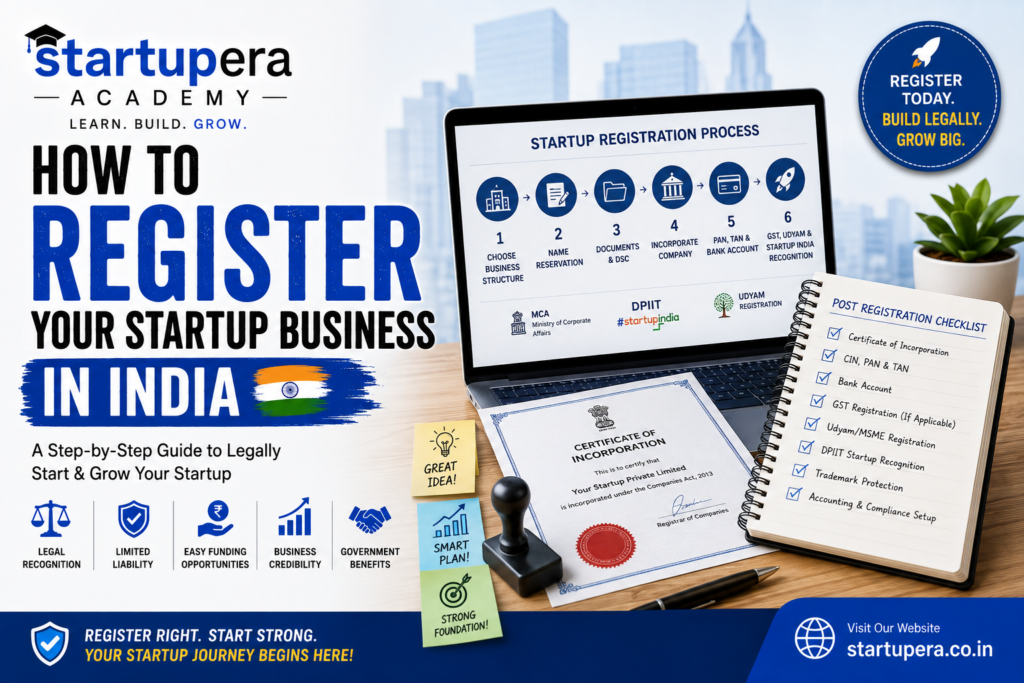
Startup Registration Roadmap
Startup Idea
↓
Choose Business Structure
↓
Choose & Check Name
↓
Founder & Ownership Planning
↓
DSC & MCA Account
↓
SPICe+ Part A
↓
SPICe+ Part B + Linked Forms
↓
Certificate of Incorporation + CIN
↓
PAN/TAN + Bank Account
↓
GST, if applicable
↓
Udyam/MSME, if eligible
↓
DPIIT Startup Recognition, if eligible
↓
Trademark/IP + Accounting + Compliance
↓
Launch & Grow
Common Mistakes to Avoid
❌ Choosing a company name without checking trademarks
❌ Mixing personal and business money
❌ Selecting a legal structure without considering future funding
❌ Assuming company registration automatically gives DPIIT recognition
❌ Ignoring GST requirements
❌ Paying unofficial agents for free government registrations
❌ Ignoring annual compliance
❌ Not documenting founder ownership
❌ Building the company before validating the business idea
The official Startup India portal specifically states that DPIIT recognition applications should be filed by the startup using its own details and that the Ministry does not charge a fee for DPIIT recognition. (Startup India)
Final Checklist
Before considering your startup legally and operationally set up, review:
☐ Business structure decided
☐ Company name checked
☐ Founders and ownership decided
☐ DSC arranged
☐ SPICe+ filed
☐ Certificate of Incorporation received
☐ PAN/TAN obtained
☐ Business bank account opened
☐ GST checked/registered if applicable
☐ Udyam registration considered
☐ DPIIT eligibility checked
☐ Trademark checked/protected
☐ Accounting & compliance system established
Final Thought
Registering a startup is not the same as building a startup.
Registration gives your business a legal foundation. The real work begins afterward:
Validate → Build → Sell → Serve Customers → Generate Revenue → Improve → Scale.
Before filing, verify the latest requirements on the official government portals because company, tax and startup-recognition rules can change. For situations involving legal structure, tax or compliance, professional advice from a CA/CS/lawyer is recommended.