
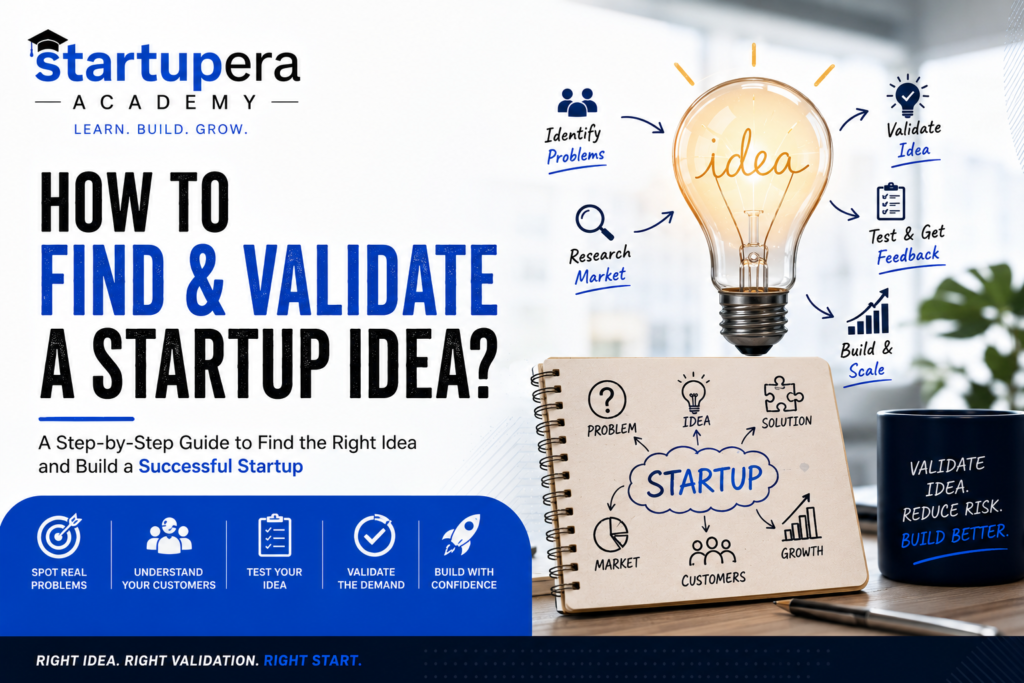
Starting a startup doesn’t begin with building an app, hiring a team, or raising funding. It begins with finding a real problem worth solving.
A good startup idea should solve a problem that people actually experience and, ideally, are willing to pay to solve.
1. Start With Problems, Not Ideas
Instead of asking, “What startup should I build?”, ask:
“What problems do people face every day?”
Look at problems in:
- Education
- Healthcare
- Finance
- Agriculture
- Transport
- Retail
- Technology
- Jobs & Skills
- Food
- Travel
- Small Businesses
Your daily experiences can also be a great source of ideas.
2. Identify a Specific Customer
Don’t try to solve a problem for “everyone.”
Define exactly who you want to help.
For example:
Problem: Small businesses struggle to get customers online.
Target customer: Local businesses with 1–20 employees.
The more clearly you understand your customer, the easier it becomes to design the right solution.
3. Talk to Potential Customers
This is one of the most important steps in idea validation.
Talk to 10–20 potential customers and ask:
- What is your biggest problem in this area?
- How do you currently solve it?
- How much time or money does it cost?
- What don’t you like about the current solution?
- Have you ever paid for a solution?
- What would an ideal solution look like?
Don’t try to sell your idea during these conversations.
Listen first.
4. Study Existing Solutions
Search for companies already solving the problem.
Check:
- Competitors
- Pricing
- Features
- Customer reviews
- Complaints
- Social media discussions
- Online communities
Competition isn’t necessarily bad.
If people are already paying for solutions, it can be evidence that the problem is real.
Your opportunity may be to solve it better, cheaper, faster or for a specific niche.
5. Check Whether the Problem Is Painful
Not every problem deserves a startup.
A strong startup problem is usually:
Frequent + Important + Expensive + Frustrating
Ask yourself:
“If this problem disappeared tomorrow, would people care?”
If the answer is yes, investigate further.
6. Create a Simple Solution
Once you understand the problem, define your solution in one sentence.
For example:
“We help local restaurants get more repeat customers through automated WhatsApp campaigns.”
If you cannot explain your solution simply, you may not understand the problem well enough yet.
7. Build an MVP
MVP stands for Minimum Viable Product.
Don’t build the complete product immediately.
Start with the simplest version that can test your assumption.
It could be:
- Landing page
- Prototype
- WhatsApp service
- Google Form
- No-code product
- Manual service
- Basic website
- Simple app
The goal isn’t to build something perfect.
The goal is to learn.
8. Test With Real Users
Give your MVP to real potential customers.
Observe:
- Do they use it?
- Do they understand it?
- Does it solve their problem?
- Do they come back?
- Would they recommend it?
- Would they pay for it?
Real user behavior is more valuable than compliments.
Someone saying “Great idea!” is not validation.
Someone saying “I’ll pay for this” is much stronger evidence.
9. Test Willingness to Pay
One of the strongest forms of validation is getting customers to pay.
You can test:
- Pre-orders
- Paid pilots
- Subscription
- Consultation/service fees
- Deposits
- Early-access plans
If nobody is willing to pay, find out why.
The problem could be:
- Wrong customer
- Wrong pricing
- Wrong solution
- Problem isn’t important enough
- Poor positioning
10. Measure Your Results
Create simple metrics.
Track:
Number of people interviewed → Users who tried → Users who returned → Paying customers
For example:
100 people interviewed
↓
30 interested
↓
15 tried the MVP
↓
8 became regular users
↓
5 paid
This gives you much better information than simply counting Instagram followers or website visitors.
11. Improve Based on Feedback
Don’t become emotionally attached to your first idea.
Use feedback to improve:
Build → Test → Learn → Improve → Repeat
You may discover that the original idea needs to change.
That’s not failure.
That’s validation.
The Startup Idea Validation Framework
Before investing heavily, answer these 7 questions:
1. Problem
What problem are we solving?
2. Customer
Who has this problem?
3. Frequency
How often does the problem occur?
4. Existing Solution
How do people solve it today?
5. Advantage
Why would they choose us?
6. Willingness to Pay
Will customers pay for our solution?
7. Scale
Can this become a large and sustainable business?
If you can confidently answer these questions, you have a much stronger foundation for your startup.
Common Mistakes to Avoid
❌ Building before talking to customers
❌ Assuming everyone is your customer
❌ Copying another startup without understanding the market
❌ Spending heavily on technology too early
❌ Ignoring competitors
❌ Taking positive feedback as validation
❌ Focusing on funding before customers
❌ Refusing to change the idea when evidence says otherwise
Final Formula
Problem → Customer → Research → Validate → MVP → Test → Get Paid → Improve → Scale
Remember:
Don’t fall in love with your idea. Fall in love with solving the customer’s problem.
A startup idea becomes a real business only when a real customer finds enough value in the solution to use it and pay for it.