
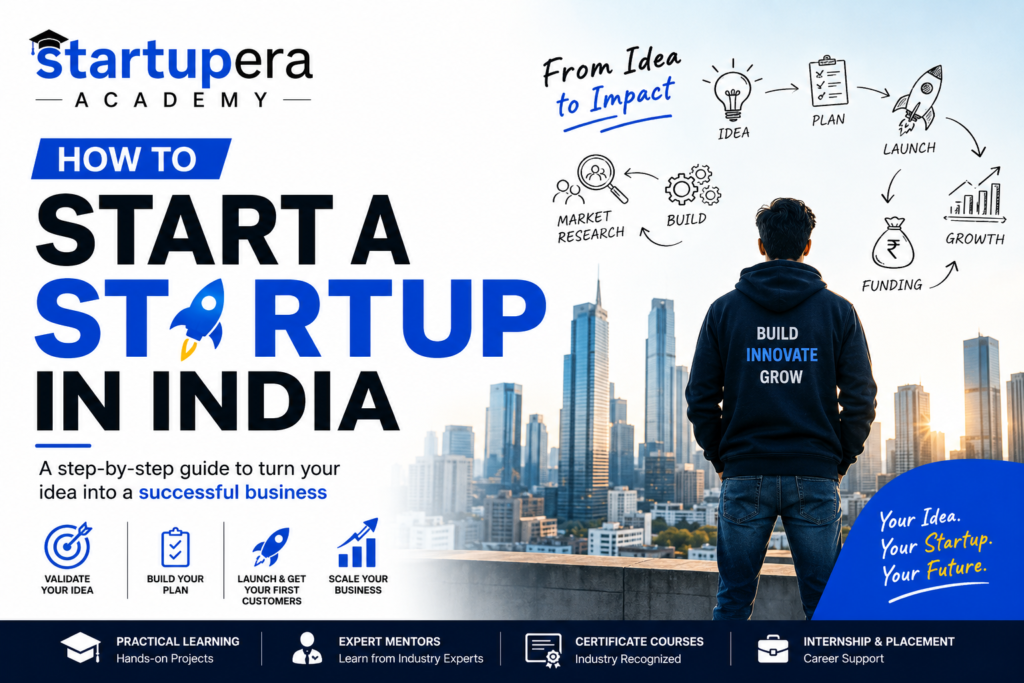
Starting a startup in India is easier than ever in terms of access to technology, digital infrastructure, customers, mentors and government support. But registering a company is only one small part of building a successful startup.
The real journey starts with finding a problem, validating the solution, getting your first customers and building a sustainable business.
Here is a practical roadmap for anyone who wants to start a startup in India.
1. Start With a Problem, Not Just an Idea
A startup should solve a real problem.
Instead of asking:
“What business should I start?”
Ask:
“What problem do people have that I can solve better, faster or cheaper?”
Look for problems in areas such as:
- Education
- Healthcare
- Finance
- Agriculture
- Logistics
- E-commerce
- SaaS
- AI
- Travel
- Food
- Climate & sustainability
- Local businesses
- Employment and skills
Talk to potential customers before spending significant money on development.
2. Research Your Market
Once you identify a problem, understand the market.
Research:
- Who has this problem?
- How many potential customers are there?
- What are they currently using?
- Who are your competitors?
- How much are customers willing to pay?
- What makes your solution different?
Don’t assume there is a market simply because you think the idea is good.
Customer conversations are more valuable than assumptions.
3. Define Your Business Model
Decide how your startup will make money.
Common models include:
- Subscription
- Commission
- Marketplace
- SaaS
- Advertising
- Freemium
- Transaction fee
- Direct product sales
- Service-based model
- Licensing
For example:
Problem → Solution → Customer → Revenue Model → Distribution Channel
Keep the first version of your business model simple.
4. Build an MVP
MVP means Minimum Viable Product.
It is the simplest version of your product that allows you to test whether customers actually want your solution.
You don’t necessarily need a sophisticated app on day one.
Your MVP could be:
- Landing page
- WhatsApp-based service
- No-code website
- Prototype
- Google Form
- Manual service
- Basic mobile application
- Simple SaaS product
The goal is:
Build → Launch → Get Feedback → Improve.
5. Get Your First Customers
This is one of the most important stages.
Don’t wait until everything is perfect.
Try to get your first:
5 → 10 → 50 → 100 customers.
Talk directly to users and understand:
- Why did they buy?
- What did they like?
- What didn’t they like?
- Would they recommend it?
- What would make them pay more?
Your first customers can help shape your product.
6. Choose the Right Legal Structure
In India, entrepreneurs commonly consider:
- Sole Proprietorship
- Partnership Firm
- Limited Liability Partnership (LLP)
- Private Limited Company
For a startup that plans to raise external equity investment, a Private Limited Company is often considered because of its suitability for issuing shares and structuring investment.
The right structure depends on your business, ownership, liability, funding plans and compliance requirements. Take professional legal/tax advice before deciding.
For company incorporation, the Ministry of Corporate Affairs uses the SPICe+ incorporation process, which integrates several services including company registration and PAN/TAN, with GSTIN available through the integrated process where applicable.
7. Register Your Business
Once you’ve decided on the structure, complete the relevant registrations.
For a company, this generally involves:
- Choosing a business name
- Digital Signature Certificates
- Director/partner details as applicable
- Registered office
- Incorporation documents
- PAN/TAN
- Bank account
- Other applicable registrations
For a Private Limited Company, incorporation is handled through the MCA’s SPICe+ system.
8. Get DPIIT Startup Recognition
DPIIT recognition can provide access to various Startup India benefits and ecosystem initiatives.
Under the current Startup India criteria, eligible entities can include:
- Private Limited Companies
- LLPs
- Registered Partnership Firms
- Cooperative Societies
For a standard startup, the entity must generally be within 10 years of incorporation, have turnover below ₹200 crore in any financial year, not have been formed by splitting/reconstructing an existing business, and work toward innovation/improvement or have a scalable model with potential for employment or wealth creation.
Applications for DPIIT recognition are currently routed through the National Single Window System (NSWS).
Importantly, the government states that it does not charge a fee for DPIIT Startup Recognition and has not appointed private agencies to obtain the certificate on its behalf.
9. Consider MSME / Udyam Registration
Depending on your business, Udyam Registration may also be relevant.
The official Udyam portal states that registration is free, paperless and based on self-declaration, and there is no requirement for renewal.
Current MSME classification limits are based on investment and turnover:
| Category | Investment | Turnover |
|---|---|---|
| Micro | Up to ₹2.5 Cr | Up to ₹10 Cr |
| Small | Up to ₹25 Cr | Up to ₹100 Cr |
| Medium | Up to ₹125 Cr | Up to ₹500 Cr |
Whether you should register depends on your business and the benefits you want to access.
10. Protect Your Brand and Intellectual Property
Before investing heavily in your brand, check whether the name is available.
Consider protecting:
- Brand name
- Logo
- Trademark
- Domain name
- Software/code
- Designs
- Patents, where applicable
- Proprietary processes
- Customer and business data
For eligible DPIIT-recognized startups, Startup India provides intellectual-property support, including access to facilitators and a significant rebate on patent filing fees.
11. Set Up Your Financial System
Don’t mix personal and business finances.
Set up:
- Business bank account
- Accounting system
- Invoicing
- Expense tracking
- Payroll process
- Tax compliance
- Financial reporting
Track important numbers such as:
Revenue + Expenses + Gross Margin + Cash Flow + Customer Acquisition Cost + Customer Lifetime Value
A startup can have strong sales and still fail because it runs out of cash.
12. Understand GST and Other Compliance
GST registration and other tax registrations depend on factors such as your business activity, turnover, location and applicable rules.
Don’t register or avoid registration based purely on what another startup does.
Check the current requirements with a CA/tax professional before launching commercial operations.
Also consider applicable:
- Income-tax compliance
- GST compliance
- TDS
- Labour regulations
- Shops & Establishments requirements
- Sector-specific licences
- Data/privacy requirements
- Import/export registrations, if applicable
13. Build Your Brand
Your startup needs a clear identity.
Create:
- Brand name
- Logo
- Website
- Social media profiles
- Brand messaging
- Product presentation
- Pitch deck
- Company profile
But don’t spend your entire budget on branding before proving that customers want your product.
Product validation comes first. Branding should support the business.
14. Build a Customer Acquisition Strategy
A great product doesn’t automatically get customers.
Choose your acquisition channels based on your target audience.
You could use:
- SEO
- Social media
- Content marketing
- Google Ads
- Meta Ads
- Influencer marketing
- Email marketing
- Partnerships
- Referral programs
- Direct sales
- Communities
- Events
Start with one or two channels instead of trying everything simultaneously.
15. Build Your Team
Don’t hire a huge team immediately.
Start with people who can directly contribute to:
- Product
- Technology
- Sales
- Marketing
- Operations
- Customer success
Early-stage startups should prioritize skills and ownership over job titles.
16. Decide When to Raise Funding
Not every startup needs venture capital.
You can start with:
Bootstrapping
Use your own savings and revenue.
Friends & Family
Raise early capital from your personal network.
Angel Investment
Raise from individual investors.
Venture Capital
Raise institutional investment when the business has the potential for significant scale.
Grants & Government Schemes
Explore applicable government programs.
For example, the Startup India Seed Fund Scheme provides eligible DPIIT-recognized startups support for proof of concept, prototype development, product trials, market entry and commercialization. The scheme currently describes support of up to ₹20 lakh as a grant for specified validation/prototype/product-trial purposes and up to ₹50 lakh as investment for market entry, commercialization or scaling through specified instruments, subject to eligibility and scheme conditions.
Startup India also provides access to resources such as Investor Connect, Fund of Funds and mentorship initiatives.
17. Create a Pitch Deck
If you’re looking for investors, prepare a clear pitch deck.
A typical deck includes:
- Problem
- Solution
- Product
- Market
- Target Customer
- Business Model
- Competition
- Competitive Advantage
- Traction
- Marketing Strategy
- Team
- Financials
- Funding Requirement
- Use of Funds
Keep it simple.
Investors should understand your business within a few minutes.
18. Measure What Matters
Don’t focus only on followers, downloads or website traffic.
Track:
- Revenue
- Monthly recurring revenue
- Number of customers
- Conversion rate
- Customer acquisition cost
- Customer retention
- Churn
- Gross margin
- Cash burn
- Runway
Your startup should gradually move from:
Idea → MVP → First Customer → Product-Market Fit → Growth → Scale
19. Scale Only After Validation
One of the biggest startup mistakes is scaling too early.
Don’t spend ₹10 lakh trying to acquire customers when you haven’t figured out whether customers will pay ₹1,000 for your product.
First prove:
People need it → People use it → People pay for it → People come back.
Then scale.
Startup Roadmap in One Line
Problem → Research → Idea → Validation → MVP → First Customers → Business Model → Registration → DPIIT/MSME → Product-Market Fit → Revenue → Team → Funding → Growth → Scale
Final Advice
Starting a startup in India doesn’t require a massive office, a large team or millions of rupees.
What you need first is:
A real problem + a useful solution + paying customers + disciplined execution.
Government programs can help with recognition, funding, intellectual property and ecosystem access, but government recognition is not a substitute for a good business.
If you’re starting from zero, focus on the first 90 days:
Month 1: Problem research + customer interviews
Month 2: MVP + testing
Month 3: First customers + feedback + business validation
Only after that should you aggressively invest in hiring, technology and growth.
The best time to start is not when everything is perfect. Start small, validate quickly and build from what the market tells you.
Note: Registration, tax, GST, funding and eligibility rules can change. Verify current requirements on the relevant government portals or with a qualified CA/company secretary/lawyer before taking legal or financial action.